

Many baseball enthusiasts believe that as long as the grip tape is not torn, it can be used indefinitely and there is no need to replace it frequently. In fact, the grip tape is by no means an accessory that can go without replacement for a long time. Just like other baseball accessories, it has its own service life and is a consumable item — it's just that many people fail to notice the hidden "expiration signals" in the details.
A new baseball bat grip tape features textures on its surface, which plays a vital anti-slip role. Besides, the grip tape acts as a buffer layer connecting your palm and the bat. Its shock-absorbing function can help you absorb part of the counter-shock force from the bat when hitting the ball, which not only prevents blisters on your palm, but also allows you to firmly lock the grip the moment you swing the bat. However, as you swing the bat again and again and clench it repeatedly during training, the material of the grip tape will gradually age under continuous pressure and friction. It will not only lose its elasticity, but its anti-slip textures on the surface will also be worn smooth and shiny. At this stage, the functions it can provide are almost negligible.
Many people still judge whether the grip tape needs to be replaced by checking "whether there are holes on the surface". But in fact, before the grip tape shows obvious damage, it has already quietly entered the "replacement-needed" state. You can recall your recent training: do you always feel that your palm tends to slip when gripping the bat? Is the soreness in the palm more obvious than before after finishing a set of hits? These are not problems caused by your poor state — they are exactly the reminders from the grip tape that it's time to replace it.
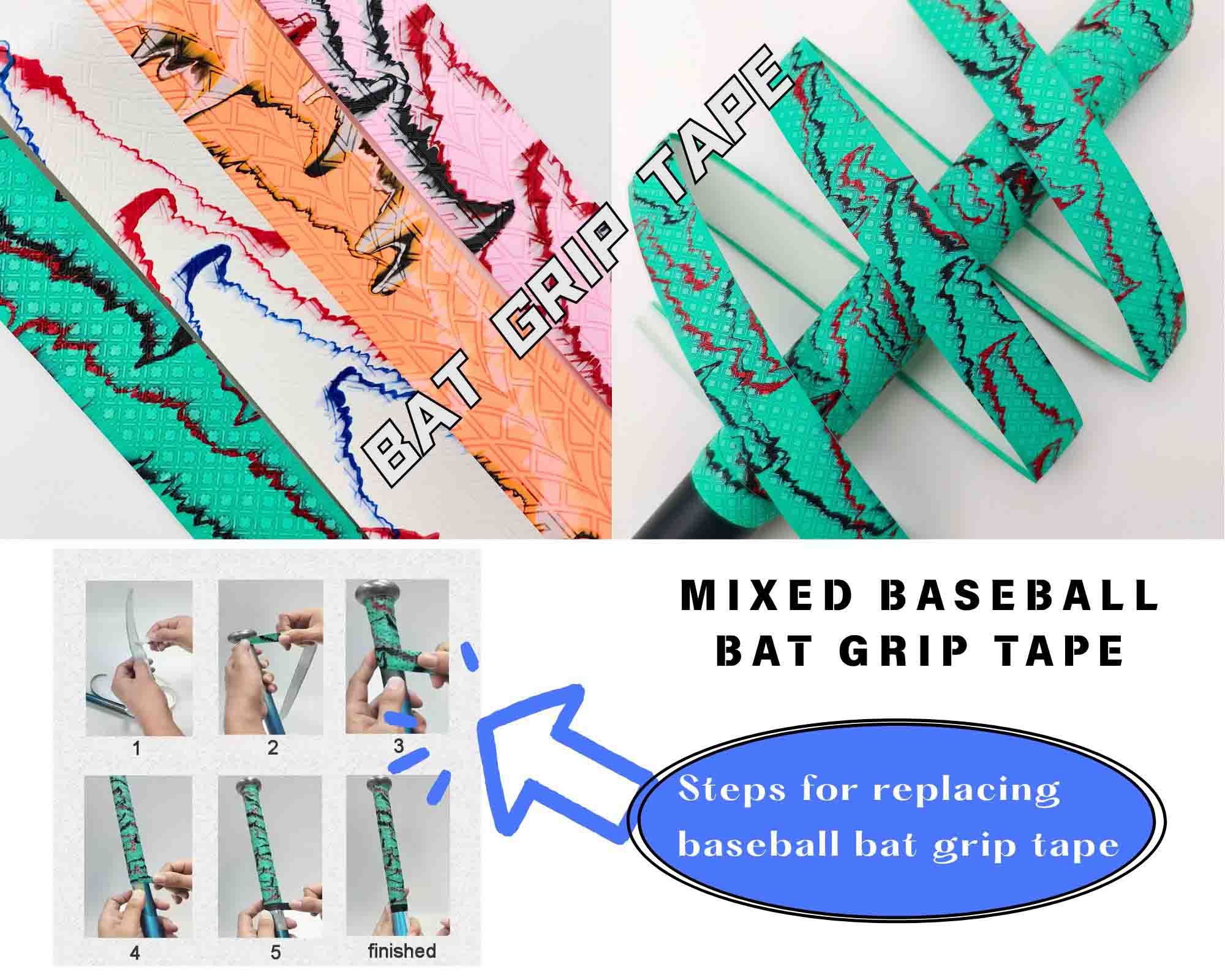
Especially in hot summer, the sweat seeping from your palm during training will gradually penetrate into the fiber gaps of the grip tape. Even if you dry it in a ventilated place after each use, the residual salt will slowly corrode the grip tape, leading to partial warping and sticky surface. In this state, the grip tape not only fails to provide anti-slip performance, but also disrupts your original force rhythm by sticking to your palm at the critical moment of swinging.
The service life of the grip tape varies completely with different usage frequencies. If you only play casually once or twice a week and train for one or two hours each time, a qualified grip tape can generally last for 1 to 2 months. But if you are a school team player or professional who spends almost every day on the field and completes hundreds of swings in each training session, your grip tape may reach the end of its service life in just 2 to 3 weeks.
In fact, replacing the baseball bat grip tape is never a trivial waste of money — it is directly related to the safety and performance of every swing you make. Next time you pick up the bat to get on the field, take 10 seconds to touch your grip tape: if its surface is worn shiny, feels hard without rebound, or even the edges have begun to warp slightly, don't hesitate to remove the old one and replace it with a new roll. You will find that such a small action can help you regain the steady sense of security when gripping the bat, and make the force of every swing transmit to the top of the bat more smoothly. After all, for baseball, every detail affects your final performance.
Please Read On, Stay Posted, Subscribe, And We Welcome You To Tell Us What You Think.
Connect With Us


Copyright @2024 Xiamen Keet Sports Technology Co., Ltd. All Rights Reserved. Sitemap/Blog/Xml/Privacy Policy  Network Supported