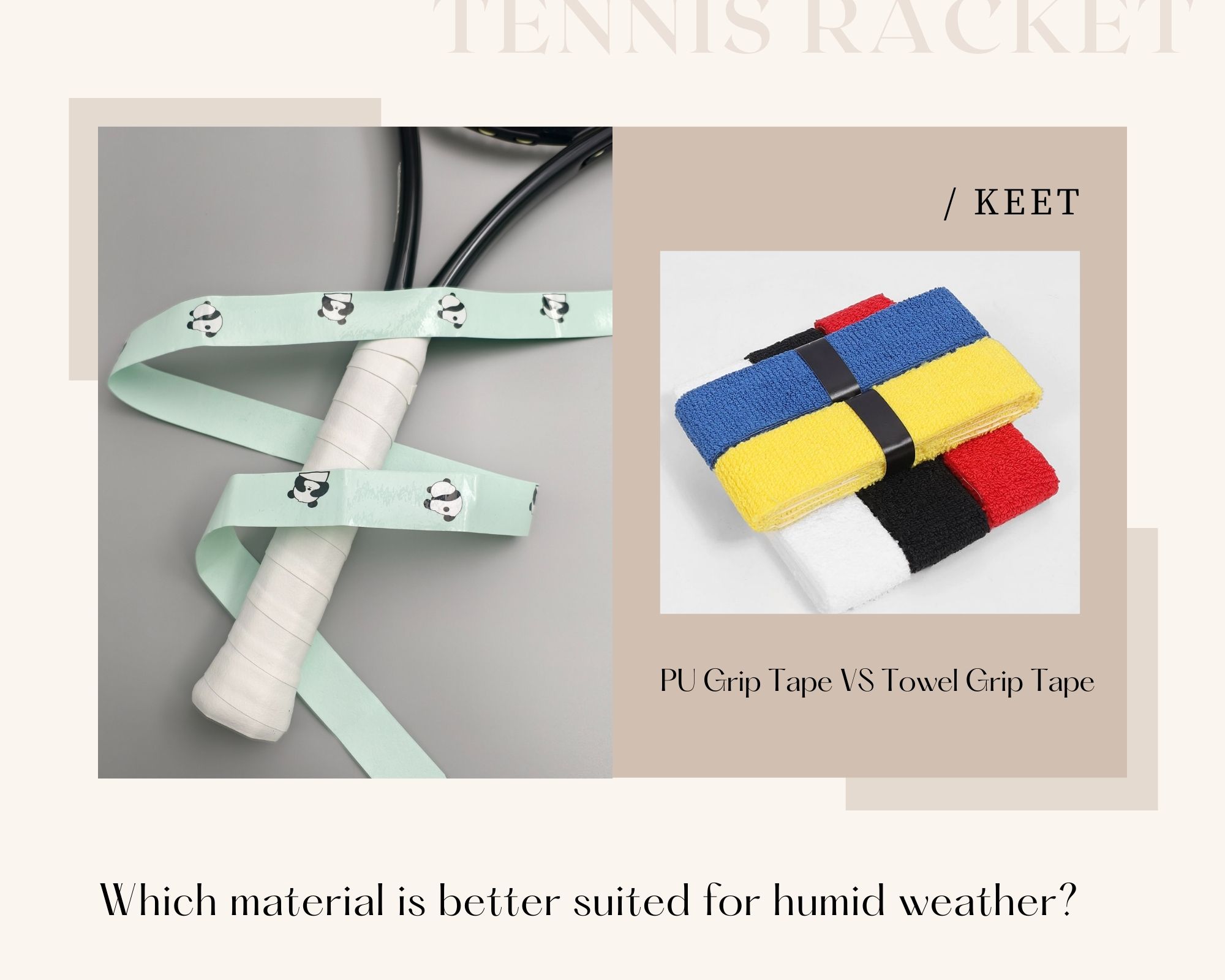
PU Grip Tape VS Towel Grip Tape: Which material is better suited for humid weather?
Feb 03, 2026
In humid weather, the anti-slip performance of a badminton racket handle directly affects shot accuracy and athletic safety. When the combined effects of hand perspiration and air moisture come into play, the choice of grip tape material becomes crucial. As mainstream options, PU grip tapes and towel grip tapes exhibit significant differences in sweat absorption, durability, tactile feedback, and other aspects. This article provides a comparative analysis from three perspectives—material properties, real-world performance, and applicable scenarios—to offer a scientific basis for selecting grip tapes in humid weather.
I. PU Grip Tape: The balancer of anti-slip and durability
PU grip tapes are primarily made of polyurethane (PU) and achieve anti-slip functionality through surface embossing or perforation designs. Their thickness typically falls into two categories: thin and thick. Thin variants lack adhesive on the back and require finishing tape for secure attachment, while thick variants come with double-sided adhesive for direct wrapping and reinforcement. Experimental data shows that high-quality PU grip tapes can maintain a friction coefficient above 0.45 in 80% humidity environments, sufficient for moderate levels of hand perspiration.
The advantages of PU grip tapes lie in their durability and ease of maintenance. PU materials are highly resistant to aging, making them less prone to cracking or deformation even with frequent use. Additionally, PU grip tapes are easy to replace. Thin variants allow for fine-tuning of handle thickness by adjusting the number of wraps, catering to amateur players seeking precise racket control.
However, the sweat absorption capacity of PU grip tapes has limits. When hand perspiration exceeds 50 ml per hour, their surface gradually becomes saturated, leading to a decline in anti-slip performance. In such cases, increasing the replacement frequency (recommended every 2-3 games) is necessary. Professional players rarely opt for pure PU grip tapes in humid weather, primarily because their sweat absorption capabilities cannot meet the demands of high-intensity competitions.
II. Towel Grip Tape: The ultimate solution for sweat absorption and tactile feedback
Towel grip tapes are made of cotton materials, enabling them to absorb over eight times their own weight in sweat. In 90% humidity environments, the surface moisture of towel grip tapes rises 40% slower than that of PU grip tapes and leaves no sticky residue after drying.
The towel grip tape core strengths lie in instant sweat absorption and tactile feedback. The capillary action of cotton materials rapidly channels hand perspiration into the fibers, keeping the surface dry. Professional players like Kento Momota choose towel grip tapes to maintain racket grip stability in Southeast Asia's humid tournament venues. Moreover, the soft texture of towel grip tapes reduces hand fatigue, making them particularly suitable for technically skilled players who frequently change their grip styles.
Nevertheless, durability is a weakness of towel grip tapes. After three uses, the fiber gaps can harden due to salt crystallization from sweat, requiring cleaning with a neutral detergent and air-drying to restore performance. Additionally, wrapping towel grip tapes demands greater skill; if not tightly wrapped or sealed at the edges, they are prone to loosening during play.
There is no absolute winner among grip tape types, only precise matching matters. In humid weather, towel grip tapes remain the top choice for people who sweat a lot due to their instant sweat absorption and tactile advantages. However, for players with moderate hand perspiration or those seeking cost-effectiveness, PU grip tapes can still perform adequately with proper maintenance. As a professional coach once said, "The ultimate goal of a grip tape is to make players forget its existence."




 Network Supported