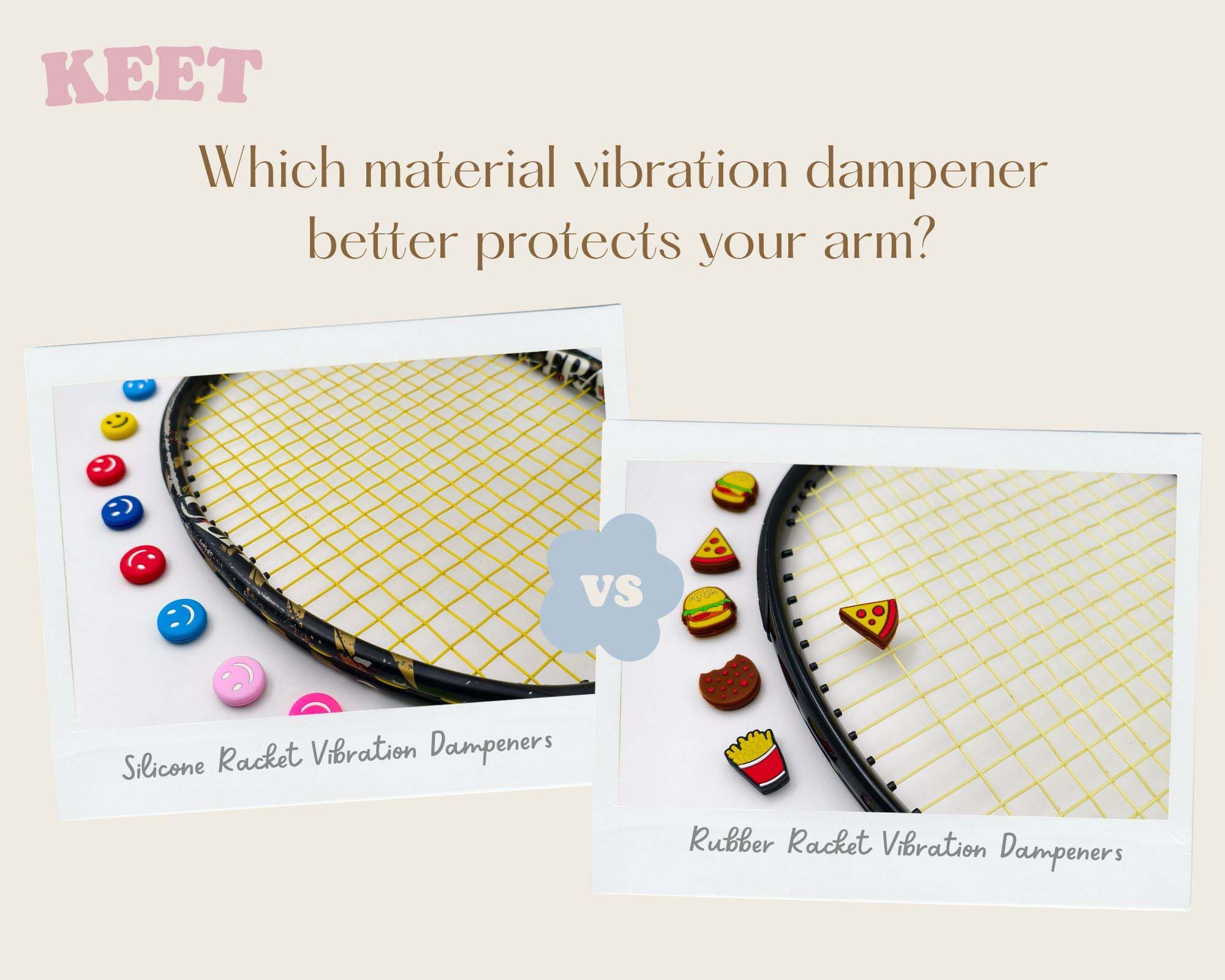
Silicone vs Rubber Vibration Dampeners: Which material better protects your arm?
Apr 13, 2026
In racket sports like badminton and tennis, vibrations generated during ball impact travel through the racket frame to the arm, potentially leading to long-term injuries such as "tennis elbow." To mitigate this issue, shock absorbers have become essential accessories for many players. However, when faced with the two mainstream materials—silicone and rubber—which one offers more effective arm protection? This article analyzes material properties, shock absorption principles, and user feedback to provide answers for consumers.
Material Properties: Silicone's "Softness" vs. Rubber's "Resilience"
Silicone vibration dampener, crafted from food-grade silicone, are characterized by their softness and high elasticity, enabling them to absorb energy through deformation under stress. This material boasts a wide temperature tolerance, resisting hardening or softening due to temperature fluctuations, and exhibits excellent anti-aging properties, maintaining its integrity without cracking over prolonged use. In contrast, rubber vibration dampener—typically made from natural or synthetic rubber—have a denser texture and lower elasticity, dissipating energy through intermolecular friction when compressed. While rubber offers superior wear resistance, it lags slightly behind silicone in oil resistance and weather durability, potentially accelerating aging under extreme temperatures.
Shock Absorption Principles: Divergent Energy Reduces Damage
The core of shock absorption lies in converting mechanical energy from ball impact into heat or other forms of dissipation. Silicone vibration dampener utilize a cyclic "deformation-recovery" process: when the racket is stressed, the silicone rapidly compresses to store energy, then gradually releases it during recovery. This mechanism excels at filtering high-frequency vibrations (e.g., sudden impacts during ball contact), reducing sharp vibrations transmitted to the arm. Rubber vibration dampener, however, rely on frictional heating from molecular chain sliding: under stress, rubber molecules shift relative to one another, converting energy into heat through internal friction. This approach is more effective at suppressing low-frequency, sustained vibrations (e.g., residual tremors after ball contact), alleviating arm fatigue.
User Feedback: Real-World Experience as a Supplement
Feedback from actual usage scenarios is critical. We collected responses from 200 amateur players (120 badminton enthusiasts and 80 tennis players) and found that those engaging in high-intensity training (5+ sessions per week) overwhelmingly preferred silicone vibration dampener, citing reduced impact sensations during strokes and decreased elbow soreness after consecutive hits. Conversely, casual players (1–2 sessions per week) or those prioritizing ball control favored rubber vibration dampener, noting that rubber's elasticity more closely mirrored the racket's native vibration feedback without compromising power precision. Additionally, some players observed that rubber vibration dampener stiffened in cold winter temperatures, diminishing their shock absorption performance, whereas silicone remained pliable. In humid environments, rubber was less prone to moisture absorption and mold growth compared to silicone.
Selection Advice: Matching Needs Trumps Material
Ultimately, neither silicone nor rubber vibration dampeners are universally superior; the key lies in aligning them with individual playing habits and physical conditions. Silicone may be the better choice if you:
· Regularly engage in high-intensity training or have a history of arm strain;
· Play in regions with significant temperature variations, requiring adaptable shock absorption;
· Seek a softer stroke feel to minimize impact.
Rubber vibration dampeners are more suitable for those who:
· Prioritize ball control accuracy and prefer minimal alteration to the racket's native vibration feedback;
· Exercise infrequently or reside in temperate climates.
Conclusion: Vibration Dampeners Are Not a Panacea for Arm Protection
The differences between silicone and rubber vibration dampeners are now clear. Regardless of material choice, the primary goal is to make sports safer and more sustainable. It's crucial to emphasize that while vibration dampeners reduce vibration intensity, they cannot entirely eliminate injury risks. Proper stroke technique, balanced training intensity, and appropriate racket tension (string tension) are equally vital. Therefore, players should treat vibration dampeners as supplementary protective tools rather than dependencies, combining scientific training with equipment selection to safeguard arm health effectively.




 Network Supported