What are the differences between the tennis overgrips and badminton overgrips?
Feb 05, 2026
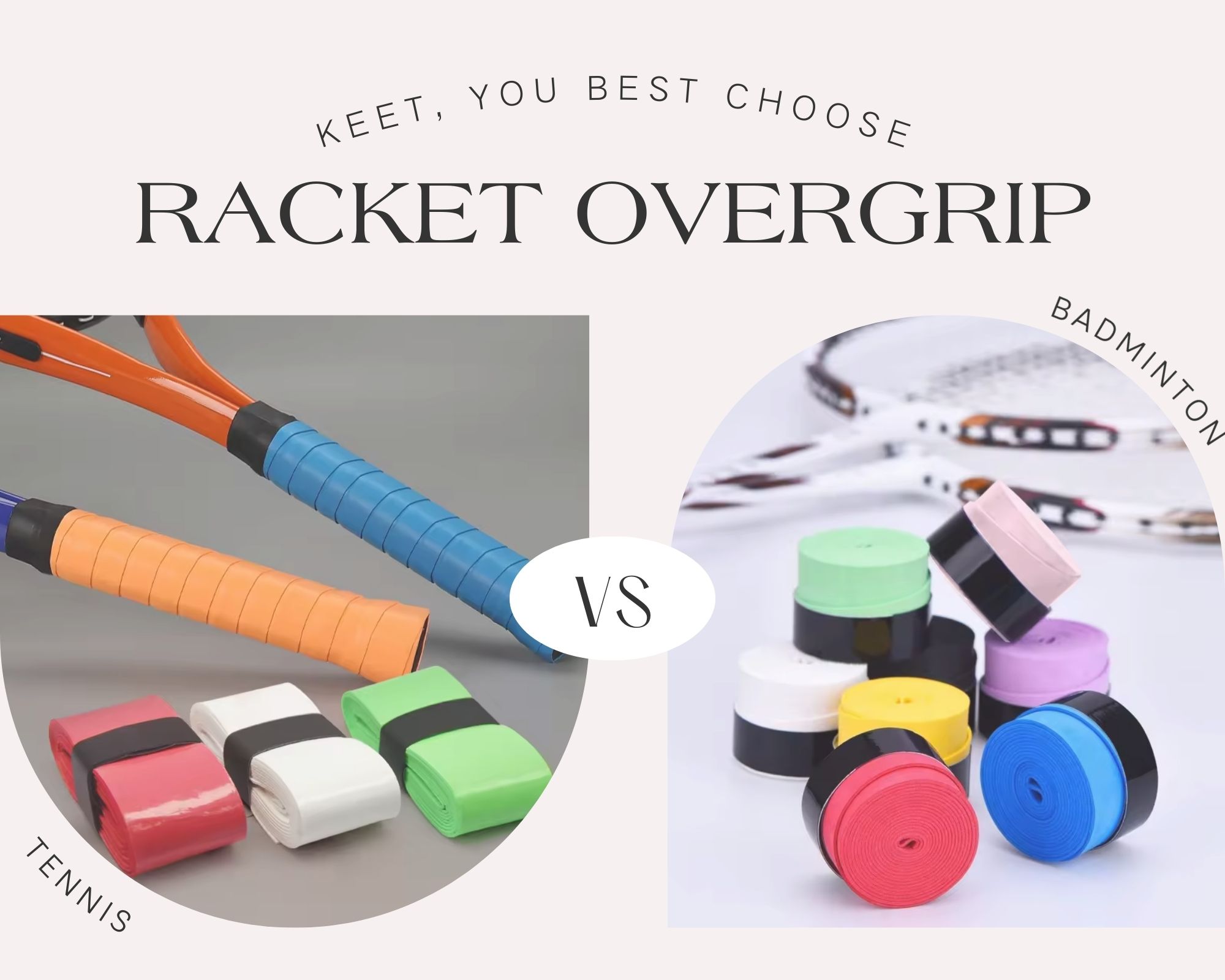
In tennis and badminton, overgrips serve as the "second skin" connecting players to their rackets, with design variations directly influencing athletic performance and experience. While both fulfill fundamental functions such as anti-slip, sweat absorption, and shock absorption, differences in sports characteristics, racket structures, and force application methods result in notable distinctions in material, thickness, and application scenarios between tennis and badminton overgrips.
1.Material Selection: Durability vs. Sweat Absorption
Tennis overgrips predominantly feature polyurethane (PU) or composite fibers, materials known for their high abrasion resistance, capable of withstanding friction on clay courts, impacts from high-pressure shots, and frequent racket frame scratches. For instance, professional tennis overgrips offer superior durability and significantly longer lifespans compared to badminton overgrips, while also better cushioning shot vibrations to protect wrist joints.
Badminton overgrips prioritize sweat absorption, with a trend toward material diversification. Perforated PU overgrips enhance breathability, keeping palms dry during rapid swings; towel overgrips centered on pure cotton fabrics, absorb over three times their weight in sweat but have weaker durability, requiring replacement every 4-5 games; keel overgrips increase friction through built-in ridges, commonly used by beginners or those with minimal hand sweat, though potentially compromising tactile sensitivity.
2.Thickness Design: Cushioning Needs vs. Operational Precision
Tennis overgrips are thicker. Tennis racket handles are generally thicker and longer, necessitating thicker overgrips for support. Standard tennis overgrips measure 0.6-0.8 millimeters in thickness, a design that disperses impact forces during shots, reduces wrist fatigue, and accommodates wide-arc swinging motions.
Badminton overgrips adhere to a "thin" core philosophy, with thickness typically controlled at 0.5-0.6 millimeters. Ultra-thin designs reduce handle weight, enhancing swing speed, particularly suited for grip styles requiring rapid forehand-backhand transitions. Professional players may further refine handle thickness by wrapping multiple thin layers or removing the inner grip, pursuing ultimate ball control.
3.Scenario Adaptation: Tennis vs. Badminton
Tennis characterized by long-distance running and high-pressure shots, demands overgrips that balance durability and shock absorption. For example, hard court players tend to choose highly abrasion-resistant PU overgrips, while clay court players may opt for rougher-surfaced overgrips to enhance friction. Additionally, tennis overgrips often feature widened securing tapes at the base to prevent loosening during vigorous swings.
Badminton emphasizes rapid reactions and agile maneuvering, requiring overgrips that balance sweat absorption and lightweight design. For instance, singles players may select ultra-thin, sticky overgrips to improve ball control precision, while doubles players prefer towel overgrips to address hand sweat issues during intense rallies. Furthermore, badminton overgrips frequently employ gradient-thinning edge processes to avoid overly thick wrapping that could affect net shot touch.
Although tennis and badminton overgrips share similar lengths, interchanging them has limitations. Applying a tennis overgrip to a badminton racket thickens the handle, impairing forehand-backhand transition flexibility; using a badminton overgrip on a tennis racket may reduce abrasion resistance due to insufficient thickness, increasing replacement frequency. From material selection to craftsmanship design, the differences between tennis and badminton overgrips fundamentally reflect the sports' unique characteristics. Tennis overgrips adopt a "thick, durable, stable" approach to withstand high-intensity impacts, while badminton overgrips pursue "thin, absorbent, sensitive" qualities for ultimate control. For enthusiasts, understanding these differences not only aids in selecting appropriate equipment but also allows for fine-tuning overgrips to optimize performance and enjoy the pleasures of technical refinement.




 Network Supported